
Hiring a Commercial Vehicle? How to Check Vehicle Details Before Confirming a Transport Order
A transporter shares a truck number, confirms the freight rate and promises to place the vehicle at your loading location. Everything appears ready. But have you checked whether the vehicle details match the truck being offered for your shipment?
For businesses hiring commercial vehicles, confirming a transport order involves more than agreeing on the rate, route and delivery schedule. The vehicle’s registration details, insurance status, fitness certificate and other applicable documents also need attention.
A mismatch in vehicle information or an expired document can create avoidable complications after the booking has been confirmed. This is particularly important for manufacturers, distributors, shippers and logistics companies that regularly hire trucks through transporters or brokers.
A proper commercial vehicle verification process helps businesses review important vehicle information before assigning goods to a truck. It also gives transport teams a more organised way to assess vehicles before approving a transport order.
In this guide, we explain what to check, how to verify truck details online and how TruckSuvidha can support the initial vehicle verification process.
How Do You Verify a Commercial Vehicle Before Confirming a Transport Order?
To verify a commercial vehicle, start with its registration number and compare the available vehicle details with the information shared by the transporter. Check the Registration Certificate (RC), insurance validity, fitness status, PUCC and applicable permits. Confirm that the actual truck matches the records before approving loading and dispatch.
Why Should You Check a Commercial Vehicle Before Confirming an Order?
A transport order creates an operational commitment between the business, transporter and vehicle provider. Once the truck is assigned, changing the vehicle at the last moment can affect loading schedules, delivery planning and coordination.
Consider a manufacturer dispatching machinery from Pune to a distribution centre in Delhi. The transporter shares a vehicle number and confirms that the truck is ready.
Before approving the order, the logistics team should establish:
- Does the registration information match the truck being offered?
- Is the vehicle’s insurance currently valid?
- Does it have a valid fitness certificate, where required?
- Is its Pollution Under Control Certificate (PUCC) current?
- Are the relevant permits available for the intended journey?
- Does the vehicle have the capacity and configuration required for the goods?
These checks help identify documentation gaps and inconsistencies before the shipment moves.
Vehicle verification is not a guarantee against every transport risk. However, it gives businesses a more informed starting point before committing their goods to a vehicle.
6 Important Checks Before Approving a Commercial Vehicle
1. Registration Certificate (RC): Confirm the Vehicle’s Identity
The Registration Certificate is one of the first records to review when hiring a commercial vehicle.
The RC contains important information about the vehicle and its registration. The details available for verification can help you compare the truck offered by the transporter with the vehicle represented in the records.
Check the following:
- Vehicle registration number
- Registration date and status
- Vehicle make and model
- Vehicle class or category
- Fuel type
- Engine and chassis details, where available
- Registered owner information, where available
What should you look for?
The registration number shared by the transporter should match the number displayed on the actual truck. The vehicle’s make, model and category should also be consistent with the information provided for the order.
For example, if a transporter offers a particular truck category but the available registration details show a different vehicle class, ask for clarification before approving the booking.
Do not rely only on a photograph of an RC sent through a messaging application. Compare the information with an appropriate official or online verification source.
2. Commercial Vehicle Insurance: Check the Policy Validity
Insurance is another important part of commercial vehicle verification.
Under Section 146 of the Motor Vehicles Act, 1988, a motor vehicle generally cannot be used in a public place unless the required third-party insurance policy is in force, subject to the provisions and exceptions in the Act.
Before confirming a transport order, review:
- Policy validity and expiry date
- Vehicle registration number mentioned in the policy
- Insurer details
- Policy number
- Applicable coverage
- Any relevant exclusions or conditions
Why does insurance verification matter?
A vehicle may have an insurance document, but the policy could have expired. The policy may also need closer review to understand the coverage applicable to the vehicle and its intended use.
For a business hiring a truck, the objective is to confirm that the vehicle has current and relevant insurance documentation rather than simply collecting a policy photograph.
Read the policy details and consult the insurer or insurance intermediary if the coverage is unclear.
3. Fitness Certificate: Confirm the Vehicle’s Fitness Status
A commercial truck must meet the applicable fitness requirements before operating on public roads.
Section 56 of the Motor Vehicles Act, 1988 addresses the certificate of fitness for transport vehicles. A transport vehicle must carry an effective fitness certificate in accordance with the applicable provisions.
Before approving the vehicle, check:
- Fitness certificate status
- Certificate validity or expiry date
- Vehicle registration number
- Whether the details correspond with the truck being offered
What if the fitness certificate has expired?
Do not treat an expired fitness certificate as a routine documentation issue. Ask the transporter to clarify the status and provide valid information before proceeding with the vehicle assignment.
Fitness requirements and testing arrangements can depend on applicable rules and vehicle category. Always refer to the relevant transport authority for the current requirements.
4. Pollution Under Control Certificate (PUCC): Check Current Validity
A valid Pollution Under Control Certificate is another important document to review, where applicable.
A PUCC indicates that the vehicle has undergone the prescribed emissions test and has been issued a certificate by an authorised agency.
When checking a PUCC, review:
- Vehicle registration number
- Certificate issue date
- Expiry date
- Certificate status
- Whether the vehicle details match the truck being offered
Important update for commercial vehicle operators in India
The Central Motor Vehicles (Sixteenth Amendment) Rules, 2026, notified through G.S.R. 991(E), introduced revised PUCC validity periods based on emission standards and vehicle category.
For BS-VI transport vehicles, the notified validity periods are:
| Vehicle age from first registration | PUCC validity period |
| Up to 6 years | Once every 2 years |
| More than 6 years and up to 10 years | Once every year |
| More than 10 years | Once every 6 months |
The notification also specifies different validity periods for BS-I, BS-II, BS-III and BS-IV vehicles. It includes a transitional provision for certificates issued before the amendment, with the revised periods applying on their first renewal after commencement.
Therefore, do not assume that every commercial vehicle follows the same PUCC renewal schedule. Check the vehicle’s emission category, registration date and applicable certificate validity.
5. Permit Details: Check Whether the Vehicle Can Operate on the Planned Route
A truck may have valid registration, insurance and fitness documents, but the relevant permit requirements must also be considered.
Permit requirements depend on the vehicle category, type of transport operation, route and applicable regulations.
Before confirming the order, review:
- Permit type
- Permit validity
- Applicable operating area
- Route-related requirements
- Any relevant restrictions or conditions
For example, a vehicle assigned to an interstate goods movement may need a permit appropriate for the planned operation.
Do not assume that a permit issued for one purpose or operating area automatically covers every route. Confirm the applicable requirements with the transporter or relevant transport authority.
6. Vehicle Details and Physical Condition: Match the Records With the Truck
Online vehicle verification helps you review available records, but it does not replace a physical inspection.
Before loading, confirm that:
- The registration number on the truck matches the booking details.
- The truck’s make and model correspond with the information provided.
- The vehicle body and loading configuration are suitable for the goods.
- The vehicle has the required load capacity.
- The visible vehicle condition is suitable for the intended journey.
- Any difference between the booking details and the actual truck has been clarified.
For high-value, fragile or specialised cargo, businesses may also require a more detailed physical inspection.
The purpose is to ensure that the vehicle being assigned is the same vehicle that was evaluated and approved for the transport order.
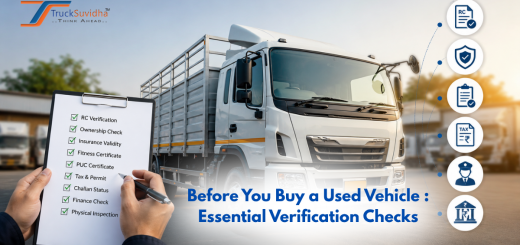
Commercial Vehicle Verification Checklist Before Confirming a Transport Order
Use this checklist as part of your transport-order approval process.
| Verification point | What to confirm |
| Vehicle registration | Registration number and available RC details match |
| Vehicle identity | Make, model and vehicle class are consistent |
| Insurance | Current policy validity and applicable coverage |
| Fitness certificate | Valid status where required |
| PUCC | Current certificate validity where applicable |
| Permit | Correct permit type and validity for the planned operation |
| Vehicle condition | Physical truck is suitable for the shipment |
| Load suitability | Vehicle capacity and body type match cargo requirements |
| Booking details | Vehicle number matches the transport order |
| Final approval | Discrepancies have been clarified before loading |
The checklist can be adapted to the type of goods, route, vehicle and applicable regulatory requirements.
How to Check Commercial Vehicle Details Online
Checking a commercial vehicle online can make the initial verification process easier, particularly when a business receives vehicle details from multiple transporters.
A practical approach is to start with the vehicle registration number.
Step 1: Collect the Vehicle Registration Number
Ask the transporter or vehicle owner to share the registration number of the truck proposed for the shipment.
Make sure the number is readable and correctly recorded in your transport-order details.
Step 2: Use an Online Vehicle Verification Service
Use an appropriate vehicle verification platform to review the available registration and vehicle information.
You can also refer to official government transport services for relevant vehicle records.
Step 3: Compare the Available Vehicle Information
Review the available details, such as:
- Registration date and validity
- Vehicle make and model
- Vehicle class
- Fuel and engine information
- Fitness certificate status
- Insurance validity
- RTO and registration information
The information available may vary depending on the source and record.
Step 4: Review the Required Documents Separately
An online vehicle record is useful for an initial check, but it should not be treated as a replacement for every underlying document.
Review the relevant insurance policy, fitness certificate, PUCC and permit information, as applicable.
Step 5: Match the Actual Truck Before Loading
When the truck reaches the loading location, compare its registration number and visible vehicle details with the approved transport order.
If the transporter changes the assigned truck, repeat the relevant verification checks for the replacement vehicle.
Step 6: Record the Verification Outcome
Maintain a simple record of:
- Vehicle registration number
- Verification date
- Documents checked
- Validity dates
- Any discrepancy identified
- Final approval status
This makes it easier for logistics and procurement teams to maintain consistent vehicle-approval records.
How TruckSuvidha Helps With Online Vehicle Verification
When a business works with multiple transporters, checking every vehicle manually can become time-consuming.
TruckSuvidha offers an online Vehicle Verification service that allows users to check available truck details using the vehicle registration number.
The service page describes access to information such as:
- Registration date and validity
- Truck make, model and variant
- Fuel type and engine details
- Fitness certificate status
- Insurance validity
- RTO details and registration location
According to the published service process, users can open the Know Your Vehicle section, enter the truck’s registration number and complete mobile-number OTP verification to access available details.
This can support the initial vehicle-screening process before a transport order is confirmed.
Explore TruckSuvidha Vehicle Verification:
Check Truck Details by Vehicle Number Online
When Can Businesses Use Vehicle Verification?
For manufacturers and shippers
Review the available vehicle details before assigning goods to a truck for dispatch.
For logistics managers
Add an initial vehicle verification step to the transport-order approval process.
For transporters and fleet owners
Review available registration, fitness and insurance information when onboarding or managing commercial vehicles.
For brokers and transport coordinators
Compare the vehicle details shared for a load with available records before confirming the vehicle assignment.
Online verification is an initial screening step. Businesses should still review current documents, applicable permits and physical vehicle condition wherever required.
Manual Document Collection vs Online Vehicle Verification
| Manual document collection | Online vehicle verification |
| Often starts with document photographs shared by the transporter | Starts with the vehicle registration number |
| Requires the team to review the shared information | Helps retrieve available vehicle information through the service |
| Document images may need separate comparison | Supports an initial check of vehicle details |
| Can involve repeated coordination | Can make the initial screening process more organised |
| Still requires validity checks | Still requires review of applicable documents and current validity |
These approaches are not alternatives to one another. A better process combines online verification with document review and physical vehicle checks.
What Should You Do If Vehicle Details Do Not Match?
If you find a mismatch during verification, avoid approving the transport order until the issue has been clarified.
Here are some practical steps:
If the registration number does not match
Ask the transporter to confirm the correct vehicle number and update the booking details.
If the make or vehicle class is different
Check whether the transporter has offered a different truck from the one originally discussed. Reassess its suitability for the cargo.
If insurance validity is unclear
Request the current policy details and confirm the applicable coverage.
If the fitness certificate is not valid
Ask the transporter to resolve the issue and provide valid fitness information before the vehicle is assigned.
If PUCC information is missing or expired
Ask for the current certificate and verify the applicable validity requirements.
If permit details are unclear
Confirm the permit requirements for the vehicle and planned route with the relevant transport authority.
Keep a record of the discrepancy and the clarification received. This creates a more transparent approval process between the business and its transport partners.
Common Mistakes Businesses Should Avoid While Hiring a Commercial Vehicle
Even experienced logistics teams can overlook important checks when dispatch schedules are tight.
Avoid these common mistakes:
- Confirming the order based only on the freight rate: A competitive rate does not establish whether the vehicle is suitable or properly documented.
- Relying only on forwarded document photographs: Compare the available details with appropriate verification records.
- Ignoring document expiry dates: A document may be available but no longer valid.
- Not checking the actual truck: The vehicle arriving at the loading point should match the approved vehicle details.
- Assuming all permits are interchangeable: Check requirements for the actual vehicle, route and transport operation.
- Skipping checks when a replacement truck arrives: A vehicle change should trigger a fresh verification of the relevant details.
- Treating online verification as a physical inspection: Registration and compliance information do not confirm the actual mechanical or physical condition of a truck.
A consistent process helps prevent avoidable confusion during vehicle assignment and dispatch.
Frequently Asked Questions
1. How can I verify a commercial vehicle before confirming a transport order?
Collect the vehicle registration number and check the available RC details, insurance validity, fitness status, PUCC and applicable permit information. Compare these details with the actual truck before approving loading.
2. Can I check truck details using a vehicle registration number?
Yes. Online vehicle verification services can provide available vehicle information using the registration number. The details accessible may vary by platform and government records.
3. What documents should I check before hiring a commercial truck?
Depending on the vehicle and intended operation, review the RC, insurance, fitness certificate, PUCC, applicable permits and tax-related information. You should also check the driver’s licence separately.
4. How can I check whether a truck’s insurance is valid?
Review the current insurance policy and its validity dates. Compare the registration number on the policy with the truck being offered. You can also check available vehicle information through appropriate official or online services.
5. Why is a fitness certificate important for commercial vehicles?
The fitness certificate is an important compliance requirement for transport vehicles under the Motor Vehicles Act. Checking its validity helps identify documentation issues before the vehicle is deployed.
6. Is PUCC required for commercial vehicles?
A valid PUCC is required as prescribed under the Central Motor Vehicles Rules. Its validity period depends on the vehicle’s emission category and applicable rules.
7. Can I verify a truck online before it reaches my warehouse?
Yes. You can use the vehicle registration number to perform an initial online check before the truck arrives. However, compare the actual vehicle with the booking information when it reaches the loading location.
8. Does online vehicle verification replace physical inspection?
No. Online vehicle verification helps review available registration and compliance information. It does not assess the actual mechanical condition, tyres, brakes, body condition or suitability of the vehicle for a particular shipment.
9. What should I do if the truck number changes after booking?
Ask the transporter to provide the replacement vehicle’s registration number. Repeat the relevant verification checks and update the transport-order records before loading.
10. How does TruckSuvidha help with commercial vehicle verification?
TruckSuvidha’s Vehicle Verification service allows users to enter a vehicle registration number and access available vehicle information, including registration details, make and model, fitness status and insurance validity. Visit the service page to explore the available verification process.
Conclusion: Verify the Vehicle Before You Approve the Transport Order
Hiring a commercial vehicle is an important operational decision. Before confirming a transport order, businesses should look beyond the freight rate and delivery schedule.
Checking the registration details, insurance, fitness certificate, PUCC and applicable permits helps create a more organised vehicle-approval process. Comparing the available records with the actual truck also helps identify discrepancies before the goods are loaded.
For businesses that regularly coordinate with transporters, brokers and fleet operators, online vehicle verification can make the initial screening process easier.
TruckSuvidha’s Vehicle Verification service helps users check available truck information using a vehicle registration number.
Planning your next goods movement? Check the vehicle details before confirming the order.
Explore TruckSuvidha Vehicle Verification
Recent Comments