
Trailer Trucks and the Future of Heavy-Duty Electric Freight in India
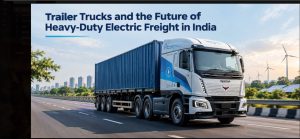
Electric trailer trucks are transforming India’s heavy-duty freight industry with lower operating costs, improved energy efficiency and sustainable transportation solutions.
The tractor-trailer is the workhorse of Indian heavy freight. It moves cement from plant to depot, steel from mill to fabricator and containers from port to inland terminal, and it does so on routes that are long, repetitive and brutally sensitive to the cost of diesel. For years the assumption was that this segment would be the last to electrify, because the loads are heavy and the distances are long. That assumption is now being tested on Indian highways, and the early results are worth understanding.
Heavy-freight electrification: opportunities and operating constraints
The case for electrifying a tractor-trailer truck rests on a simple fact: fuel is the single largest cost of operating one. On the Rhino 5538 EV, the proven economics put diesel fuel cost at roughly Rs 35 to 40 per kilometre against Rs 12 to 16 per kilometre for electric energy, which translates into an operating cost around 60 percent lower than diesel. Multiply that across a fleet and across a vehicle’s life of up to ten years and the arithmetic becomes hard to ignore.
The constraints are equally real. Batteries are heavy and expensive, so an electric tractor carries a range limit that a diesel truck does not. Charging a heavy-duty battery takes time and needs high-capacity infrastructure that cannot simply be bolted onto an existing fuel station. Because an electric truck involves a higher upfront investment, maximising vehicle utilisation is critical to achieving better returns. The more kilometres the truck covers and the more consistently it operates, the faster the initial investment is recovered. Higher utilisation translates into better ROI, improved cost efficiency per kilometre and faster payback. An electric truck delivers its true financial advantage when it stays on the road, not when it sits idle.
This is why heavy-freight electrification in India has started where the routes are fixed and the volumes are large: cement, steel, mining, port and chemical. On a defined corridor between two known points, charging can be planned, utilisation can be guaranteed and the range of the vehicle can be matched precisely to the job.
What fleet operators should assess: load, routes, charging and uptime
The first question is gross combination weight. An electric tractor that cannot pull the trailer at full legal load is not a replacement for a diesel one, so operators should check the rated GCW against their actual loading pattern. The second is route profile: total distance, gradient, how much of the run is loaded in each direction and where the vehicle can be charged. Range figures quoted under standard test conditions, typically with one side loaded and one side empty, need to be read against the real duty cycle.
Charging strategy follows from the route. Fixed charging stations placed at plant, depot and intermediate points along a corridor are the model that has worked for India’s largest deployments so far. Fast-charging capability matters because every hour a truck spends plugged in is an hour it is not earning.
Uptime is the measure that ties everything together. Heavy-duty operators are used to diesel trucks that can be repaired almost anywhere, so any electric alternative has to come with a credible commitment on availability, a service network that can actually reach the corridor and telematics that let the operator see battery health, state of charge and location in real time. With Montra Electric, servicing and vehicle uptime are never a concern. Montra Electric is committed to providing reliable, 24×7 service support, with dedicated service personnel available at the customer’s location whenever required. In the event of a breakdown, its service team is equipped to respond promptly and provide on-site assistance to minimise downtime and get the truck back on the road at the earliest. Its focus is to ensure seamless operations, faster issue resolution and maximum vehicle uptime, wherever the truck operates.
Rhino 5538 EV 6×4 Tractor Trailer as a relevant example, using verified specifications
Montra Electric’s Rhino 5538 EV, which the company describes as India’s first electric heavy commercial truck, is offered as a tractor trailer in both 4×2 and 6×4 configurations. The Rhino 5538 EV 6×4 Tractor Trailer is the variant built for demanding loads and tough gradients, with a bogie rear suspension for traction and stability where a 4×2 would struggle.
Both variants share the same core drivetrain: a permanent magnet synchronous motor producing 280 kW (380 HP) and 2,000 Nm of torque, a 6-speed automated manual transmission for a clutchless driving experience, and a 282 kWh lithium iron phosphate battery. The truck is rated for a gross combination weight of up to 55 tonnes, with 18 percent continuous gradeability. Montra Electric quotes a range of up to 168* km on a single charge for the 6×4 Tractor Trailer and 198* km for the 4×2 Tractor Trailer, with the asterisk denoting standard test conditions of one side loaded and one side empty. DC fast charging takes the battery from 20 to 100 percent SOC (State of Charge) in about 60 minutes.
The company backs the truck with 95%+ assured uptime, a comprehensive AMC covering 10 years or 9 lakh km, finance tenures of up to 10 years and telematics that report battery health, speed, real time tracking, temperature, voltage and state of charge live. The cabin is a walk-through design with a sleeper berth, tiltable steering and a four-way adjustable seat, which matters on long-haul duty.
The deployment that has drawn the most attention is Wonder Cement’s order of 250 Rhino 5538 EV 4×2 Tractor Trailers for a roughly 1,450 km corridor from Nimbahera to Dahej and Tuna across Rajasthan, Madhya Pradesh, Maharashtra and Gujarat. Across its heavy-duty electric deployments in India, Montra Electric has 850+ vehicles on the road, 35Mn+ km covered and 6.5Mn CO₂ saved.
What this suggests is not that every trailer truck in India will be electric next year, but that the segment long assumed to be untouchable has a working template. Where routes are fixed, loads are heavy and diesel bills are large, the electric tractor-trailer has stopped being a future possibility and become an operating decision.
Frequently asked questions
How far can an electric trailer truck travel on one charge?
It varies by configuration and load. The Montra Electric Rhino 5538 EV is rated for up to 198* km as a 4×2 Tractor Trailer and 168* km as a 6×4 Tractor Trailer, under standard test conditions with one side loaded and one side empty.
Which industries are adopting electric heavy trucks first in India?
Cement, coal and clinker haulage, steel, mining, port and chemical logistics, because these involve fixed corridors, high volumes and large fuel bills that make the economics work.
How long does a heavy-duty electric truck take to charge?
With DC fast charging, the Rhino 5538 EV goes from 20 to 100 percent state of charge in about 60 minutes.
Under standard test conditions – one side loaded and one side empty.

Recent Comments